

How Kojo Nnamdi became D.C.’s voice
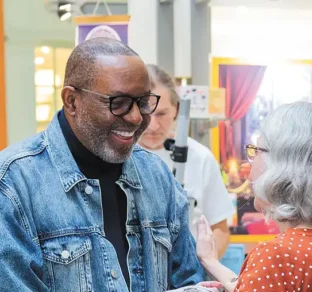 The beloved Kojo Nnamdi, 81, is finishing his memoir about life before and after a 50-year career as radio and television host. He’s still on the air every Friday at WAMU 88.5. Nnamdi will be the keynote speaker at the Beacon 50+ Expo on Nov. 8 in Silver Spring, Maryland.
Photo by Tyrone Turner/WAMU

Perhaps the best part of writing a memoir is time travel.
That’s what Kojo Nnamdi, 81, has discovered over the past several years as he wrote his memoir, which he expects will be published next year.
The longtime WAMU 88.5 host, who will be the keynote speaker at the Beacon 50+ Expo on November 8, said the writing process took him back to his childhood in Guyana, then a British colony on the Caribbean coast of South America.
“What was really pleasant for me while I was writing was to go back to the years in Guyana because those were the years that molded me into the person I am today — the influence of my parents, a gazillion relatives and the neighborhood I lived in, all combined,” he said.
Today, of course, Nnamdi is a semi-retired talk show host, on the air every Friday with “The Politics Hour with Kojo Nnamdi” on WAMU 88.5. Still in the game, Nnamdi also hosts a podcast called Young at Heart, in which he interviews older folks who have propelled to new careers — a telephone repairman, for instance, who became a shoe designer, plus several others who describe their detours.
Long journey to America
Nnamdi knows something about reinvention. He was born Rex Orville Montague Paul, but at age 26 changed his name to Kojo, a West African term for “boy born on a Monday,” and Nnamdi, after Nigeria’s first president, Nnamdi Azikiwe.
He spent his first 22 years in Georgetown, Guyana, in a house “smack-dab in the middle of the city,” next to a busy bar and a winery.
“From the moment I woke up in the morning, there was a great deal of street traffic and chatter I could hear from my window,” he recalled. “We were always entertained, daylong and night-long, by inebriated people. That was our form of television. We simply had to look out the window, and somebody was performing on the street outside our house.”
A lifelong observer of these everyday performances, Nnamdi became interested in school plays.
“My previous aspiration was to become an actor,” Nnamdi admitted. At his all-boys’ high school, he once played not only Julius Caesar but also Portia, the female character in Shakespeare’s The Merchant of Venice.
Nnamdi and his friends tended to gravitate to his house to hang out on his lively street.
“One night, an argument developed about the Vietnam War,” he remembered. “The argument got pretty loud, and when my friends left and I went upstairs, my mother said, ‘I noticed that when those guys were arguing, you were moderating the argument,’” Nnamdi said.
From an early age, he “was able to see different points of view and reconcile them,” he said, which is, of course, a crucial skill for a TV and radio host.
His mother, Gladys, also lit his path in a more practical way. Unimpressed with her son’s job selling insurance, she sent his application to McGill University in Montreal, Canada, which accepted him. Putting a plane ticket in his hand, she told him he was leaving for college in a week.
At McGill, Nnamdi made fast friends with other students, thanks to his easy-going manner.
“I’ve always considered myself a perfectly average person,” he said. “I cannot remember ever attempting to impose my will and my way on anyone else, and I’ve become convinced that maybe that’s why I was easy to get along with. I was never the most outstanding person in the group, but I was the one who all the other more quirky individuals could gather around.”
Ditching Brooklyn for D.C.
After just a year at McGill, the pull of New York City led Nnamdi to a job on Wall Street. He moved to Brooklyn in the mid-1960s during the rise of the Black Power movement. One day at lunch, a man invited him and his co-workers to join the Black Panthers. Long fascinated by activists Paul Robeson and James Baldwin, whom he read as a highschooler in Guyana, Nnamdi joined the group for several months. (Its Marxist direction eventually repelled him, he later said.)
That’s when he heard that a new school had formed in Washington, D.C., called the Federal City College Center for Black Education. “That’s where you’ll find yourself,” a cousin told him.
Sure enough, he did. “D.C. really helped me to settle down,” Nnamdi said.
Compared to New York, D.C. was “sleepy,” as the city seemed to shut down at 9 p.m. “So I said, this is a town in which I have come to work,” not necessarily to have fun, he recalled.
Slowly, though, he warmed to his somewhat rough neighborhood, Shaw.
“It was summertime, so people were out, and I began to get the same sense of community I had when I was growing up in Guyana,” he remembered.
With friends in every quadrant, he explored the city’s many areas. “I realized how vibrant a city it was, and that vibrancy showed itself fairly early.”
Nnamdi took classes and got a job at the Drum and Spear, an independent Black bookstore founded by members of the Student Nonviolent Coordinating Committee (SNCC). There he was apt to encounter famous Black writers like Amiri Baraka and Gwendolyn Brooks. He also joined a group that aired children’s plays on weekend AM radio, his first radio gig.
With that brief experience, in 1973, Nnamdi landed a “real job,” as he puts it, as news director of Howard University’s WHUR-FM station. His career blossomed from there, and from 1985 to 2011, he hosted the local TV program “Evening Exchange.”
During those years as a TV host, he became well known in the local Black community. That came in handy in the 1990s at the White House. Nnamdi was in a reception line to meet President Clinton and decided against the long wait. On his way out, some Secret Service agents recognized him and said, “Where are you going, Kojo?” They promptly escorted him to the front of the line.
White D.C. became familiar with Nnamdi in 1998, when he became WAMU host of “Public Interest,” a two-hour radio show that covered national and international topics. In 2002, that became “The Kojo Nnamdi Show,” which focused exclusively on D.C. He stepped back from his namesake show in 2021.
Hometown kids
Nnamdi raised three sons in a house on Chapin Street in Shaw. Tragically, he became a single parent after his wife died of an aneurysm when their youngest children, twin boys, were just 10 years old. His mother came from Guyana to help raise them.
He remarried in 1994, and he and his wife had two sons. All of his sons attended Howard University, not far from their home, and three of his eight grandchildren are students there now.
An expert on the city and its political history, Nnamdi has a true love for the place he once dismissed as staid. He even has a tattoo of the city’s flag on his forearm. “D.C. truly grew on me,” he said.
Young at Heart podcast
During the pandemic, Nnamdi, at the urging of a friend, pitched a podcast to WAMU about older people who reinvented themselves after retirement. Six episodes have been released so far.
As we age, Nnamdi likes to remind the listeners of what’s now Young at Heart, “It’s not over. The world doesn’t end after retirement.”
Not fully retired, Nnamdi is still in conversation with his guests, neighbors and anyone who happens to recognize him on the street, at the store, in a jazz club or on a bike trail.
Everyone seems to know Kojo Nnamdi — or at least his voice, with its low, careful cadence, punctuated by frequent chuckles. Sometimes they recognize not his face but his voice. Either way, he said, “If you know me, I know you.”
Nnamdi will be the keynote speaker at this year’s Beacon 50+ Expo on Nov. 8 at the Silver Spring Civic Building. For more information, visit thebeaconnewspapers.com/expos or call (301) 949-9766.
Cover Stories 2026