


Is a 55+ community right for you?
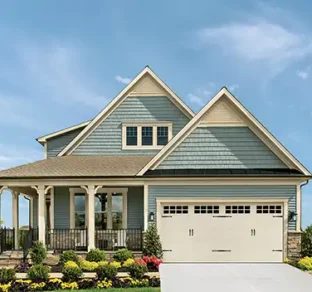 New housing communities designed for people over 55 are popping up all over the country. Bloomfields in Frederick, Maryland, is selling new homes built by NV Homes and Ryan Homes.
Photo courtesy of Bloomfields

Thinking about moving to a 55+ community? Once limited to the Sunbelt, these developments, designed for people 55 and older, can now be found throughout the nation, from Washington state to right here in Maryland.
And more of them are popping up, like two Gatherings properties, in Owings Mills and Reisterstown, and the new Merritt Station in Dundalk, which opened last fall.
Residents can enjoy a robust social life. Marilyn Burke, 60, and her husband, Martin, 66, sold their five-bedroom home in California and purchased a three-bedroom contemporary in Cresswind Wesley Chapel, a 55+ community in Monroe, N.C. Now they fill their days with trivia contests, happy hours, community concerts, pickleball and mah-jongg games.
“We wanted a community that had activities because we were moving somewhere where we knew no one,” Burke said. “We’ve met so many people from different walks of life, but with similar interests, and all from our same age group.”
The pros and cons
Like the Burkes, many older adults are drawn to 55+ communities because they want to live an active lifestyle — playing tennis or pickleball, meeting friends for coffee, joining clubs, attending educational or cultural activities and more — and they want to have plenty of amenities at their fingertips.
“They’re seeking the ability to host family and friends, explore hobbies, and maybe get into a sport they always wanted to play,” said Karl Mistry, executive vice president of Toll Brothers, a luxury builder that constructs 55+ communities under the brand name Regency. “These are active communities. The clubhouses and fitness centers are always busy.”
Many builders create developments that are akin to country clubs, with large and glitzy clubhouses, full-time lifestyle directors, on-site entertainment and dining venues. These facilities make it easy to meet new friends, socialize, get exercise, and avoid the isolation and loneliness that older adults often face.
Although many people think of a 55+ community as a place to land after they retire, you can move in before then. Residents can enjoy a low-maintenance lifestyle, with the homeowners association (HOA) handling landscaping and snow removal. Some communities offer transportation to nearby grocery stores or medical facilities for residents who don’t drive.
Keep in mind that 55+ communities differ from those that offer supportive care, such as assisted-living, memory-care and skilled-nursing facilities. These communities typically provide health care, dining and other services that vary as the needs of the residents evolve. Many of these communities also offer independent living and lots of amenities and activities.
Amenities included
Depending on the market and the development, you may pay more to buy a home in a 55+ community than a similar home in a place that’s not age-restricted.
According to the National Association of Home Builders, the median price of an age-restricted, single-family home on which construction started in 2023 was $500,000, compared with $422,000 for one that wasn’t age-restricted. That’s because the cost of the amenities is built into the home’s pricing.
You should also be prepared to pay fees. Not only do 55+ communities charge monthly HOA fees to cover operating expenses, but such communities also often charge new homeowners an up-front “initiation fee” or “entrance fee.”
Fees at even the best-run HOAs are escalating as associations struggle to keep up with increases in operating costs, particularly insurance premiums. According to an August 2024 report from real estate brokerage Redfin, which examined HOA fees in Florida over a three-month period, the median monthly fee in the Tampa area jumped 17.2% compared with the same period a year earlier. Other areas had similar increases, including Orlando (up 16.7%) and Fort Lauderdale (up 16.2%).
Many 55+ buyers finance their purchases by selling the homes they raised their families in. Some use the home equity they’ve built to pay cash for their new home; many homeowners are sitting on a pile of cash that could be available to use toward a new home when they sell.
Caution: costs may rise
Although older adults commonly assume that their living costs will decline when they downsize or move into a 55+ community, experts say that isn’t always true.
“There are a lot of extra expenses that they may not have thought about,” said Michael Silver, a certified financial planner with Baron Silver Stevens Financial Advisors in Boca Raton, Fla. “If they’re living in a community with a lot of amenities, the costs to maintain them have become astronomical, and there have been all sorts of assessments and extra fees.”
Roberta Lee knows that firsthand. Lee, 77, a retired real estate broker, purchased a house in a 55+ development in Lake Worth, Florida, in September 2022, paying $395,000. When she moved in, her monthly HOA fee was $728. Two years later, it was $961. Additionally, she paid an up-front membership fee of $10,000 for access to the on-site golf course. Back then, the monthly golf membership fee was $628; now, it’s $900.
“My home expenses, including taxes, insurance and my mortgage payment, were OK when I bought, and I thought it was a great deal,” Lee said. “Well, it turns out it’s not such a great deal.”
Lee is considering financial alternatives, such as moving, dropping out of the golf club or getting a part-time job to augment her income.
Try it on for size
If you’ve decided that living in a 55+ community may suit you, study the options in the area where you’d like to settle. Visit communities in person. Nothing substitutes for going to each community, touring the models, checking out the amenities and talking to your future neighbors.
Consider a “stay-and-play weekend,” offered by many builders to allow prospective homebuyers to stay in a home on-site and partake in activities as though they were residents. Latitude Margaritaville Hilton Head, for instance, offers stay-and-play weekends for $199 per night for two or three nights, during which you have access to all of the community’s amenities and use of a golf cart.
This article first appeared in Kiplinger Personal Finance magazine, a monthly, trustworthy source of advice and guidance. Subscribe to help you make more money and keep more of the money you make.
Margaret Foster contributed to this article.
© The Kiplinger Washington Editors, Inc. Distributed by Tribune Content Agency, LLC.
Housing 2026
#Independent Living #Housing #Savvy Senior #Retirement #The Savings Game






