


Pristine forests and colorful lakes in Banff
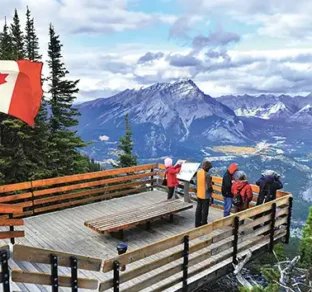 Sightseers can gaze down on the town of Banff from an overlook in Canada’s Banff National Park. A gondola whisks travelers to these viewing platforms at the summit of Sulphur Mountain in the Canadian Rockies.
© John6863373 | Dreamstime.com

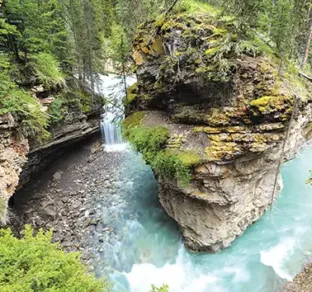 The pristine Johnston Creek skirts a massive rock formation in Johnston Canyon in Banff National Park. Suspended catwalks allow hikers to follow the creek to two waterfalls.
Photo © Nicvw | Dreamstime.com
From the turquoise and emerald lakes to the aquamarine rushing rivers to the golden larches in October, the Canadian Rockies sparkle in more vibrant colors than Crayola could conjure.
A trip to Banff and Jasper National Parks in the western province of Alberta gives travelers a glimpse of some of the most spectacular scenery in North America.
My daughter and I spent a week there last summer, arriving in the city of Calgary, about an hour and a half drive from Banff. About halfway to Banff, we were thrilled when Calgary’s flat plains suddenly shifted to snow-capped peaks in the distance.
Around town(s)
Most visitors base themselves in the town of Banff, which is in the national park itself, or Canmore, a slightly cheaper but no less picturesque town 15 miles away.
Banff National Park encompasses more than 2,500 square miles of mountains, forests, rivers and glaciers. Together with neighboring Jasper, Yoho and Kootenay National Parks, it forms part of a UNESCO World Heritage Site.
With just over 8,000 year-round residents, the town of Banff and surrounding area sees more than 4 million visitors each year. Banff Avenue, the main street, is lined with cafés, outfitters, galleries and restaurants, all framed by the towering Cascade Mountain at its northern end.
The peaks coax visitors to spend as much time outdoors as possible. Walking paths trace the Bow River through town, while nearby overlooks offer expansive views with relatively little effort. Canmore is also ringed by mountains with numerous hiking trails.
Lakes, waterfalls up close
While many vividly hued lakes dot the region, the most famous is Lake Louise, whose turquoise waters shimmer even on cloudy days. Fed by melting glaciers, the lake (as with other nearby bodies of water) owes its remarkable color to tiny particles of finely ground rock suspended in the water. Sunlight reflects off these particles, creating shades of blue that appear digitally enhanced.
Early mornings provide the calmest water and the fewest crowds. Canoes glide across the lake beneath the Victoria Glacier, while hikers can follow trails to a teahouse, pausing at panoramic overlooks. Walkers can take in the same incredible views on a lakeside trail with much flatter terrain.
Visit Moraine Lake for even more stunning blue-green water. Climb a 10-minute trail called Rock Pile (mainly consisting of rocky steps) to take it in from above, framed by spruce trees and snowy peaks. The view is so iconic it was once featured on Canada’s $20 bill.
But getting to both lakes takes advance planning and, in some cases, quick computer skills to nab a reservation on the shuttle bus. While visitors can drive to Lake Louise, its parking lot fills up by dawn in the summer. And no private cars are allowed at Moraine Lake. Parks Canada shuttles take visitors to both lakes, but reservations can be tricky to get and fill quickly when released.
Rather than play shuttle roulette, we opted to take a day trip offered by a private tour company. A small bus took us not only to these lakes, but also to the aptly named Emerald Lake, just over the border in Yoho National Park in British Columbia, and to Johnston Canyon, back in Banff National Park.
In the canyon we discovered one of Banff National Park’s most accessible hikes. Elevated catwalks hug sheer limestone walls above the rushing blue-green Bow River, leading to dramatic lower and upper waterfalls. The lower falls is about three-quarters of a mile (somewhat uphill) from the parking lot. A bridge leads to a cave where you can get an up-close view of the falls.
Go early in the morning or evening to avoid waiting in a long line, since the cave only fits a few people at once. If you have time and stamina, continue another (moderately steep) mile to the upper falls.
Another way to get a bird’s-eye view of the park is to take one of three gondolas to the top of a peak. From the Lake Louise gondola some people spot grizzlies and other wildlife, although we only saw ground squirrels.
The Banff gondola carries passengers up Sulphur Mountain on an eight-minute ride. At the summit, wooden boardwalks connect viewing platforms to take in the sweeping vistas across six mountain ranges. Exhibits explain the region’s geology and wildlife, while restaurants allow visitors to linger at sunset, when the peaks gradually fade from gold to purple.
Scenic Icefields Parkway
Some visitors end their trip through the Rockies at Lake Louise. But explore at least part of the 144-mile two-lane parkway that stretches between Lake Louise and Jasper National Park, as it is widely regarded as one of the world’s best drives.
The Icefields Parkway winds past more than 100 glaciers, aquamarine lakes, waterfalls and towering peaks, with nearly every bend revealing another jaw-dropping view.
Athabasca Falls is among the most impressive waterfalls here because of its force. The Athabasca River thunders through a narrow gorge, filling the air with mist. Nearby Sunwapta Falls makes a quieter but equally beautiful stop, where the river splits around a small island before plunging into a rugged canyon.
Keep an eye out for wildlife, including mountain goats, bighorn sheep, moose — and occasional bears, both brown and grizzly. It’s best to carry bear spray, a kind of industrial-strength pepper spray, to deter them.
The Icefields Parkway reaches its dramatic centerpiece at the Columbia Icefield. Covering more than 120 square miles, it is one of the largest accumulations of ice south of the Arctic Circle. From the parking area, visitors can walk to the edge of Athabasca Glacier in just a few minutes.
Signs marking previous glacier boundaries show how the ice has retreated dramatically over the past century as global temperatures have risen. You can ride special vehicles onto the glacier itself and walk along the nearby Glacier Skywalk, whose glass-floored observation platform extends above the Sunwapta Valley.
The parkway ends at the town of Jasper, a quieter counterpoint to Banff. It serves as an ideal base for exploring Canada’s largest Rocky Mountain national park.
But be prepared for acres of charred trees for miles before you enter the town, a third of which was decimated by wildfires that scorched both the park and town in 2024. It’s a jarring juxtaposition with the beauty of the area. We drove past remnants of the fire on the way to Maligne Lake in Jasper National Park. Stretching more than 13 miles, this is the park’s largest natural lake and home to Spirit Island, one of the most photographed locations in the Canadian Rockies.
While you can rent canoes here and at most of the lakes, visitors also have the option to take Maligne boat cruises through the glacier-fed waters to view the tiny island, a microcosm of all that is remote and beautiful in the Rockies.
If you go
United Airlines has the region’s only nonstop flight, from Dulles to Calgary, about a 90-minute drive from Banff. It’s offered seasonally from late June through late September.
Summer is peak season for tourists as well as prices — and for good reason. Snow covers the ground, and lake colors are obscured by heavy ice, often from October through May. Weather warms into the 50s and 60s in June, but it’s also the region’s rainiest month. The weather forecast showed 60 to 100% chance of rain every day during our trip at the end of June, and it did indeed rain each day. But it was also dry much of the day.
For these reasons, some think fall is the ideal time to visit, when the weather is often still in the 50s and 60s and drier. Autumn sees an uptick in visitors as the needles on the larch trees transform landscapes to a sea of gold.
Be prepared for hotel sticker shock. During the summer, it’s rare to find a hotel room or Airbnb for under $400 per night. Staying at the iconic Fairmont on the shore of Lake Louise starts at about $1,400 a night in the peak summer season ($900 in the fall), with similar prices at the Fairmont in Jasper National Park.
Travel 2026