

Robert Kanigel is a man of many stories
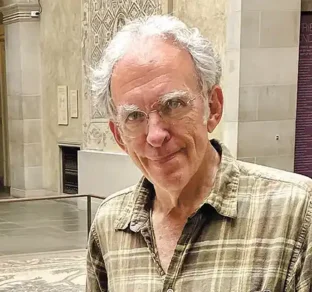 Robert Kanigel got a closer look at one of the Antioch mosaics at the Worcester Art Museum for his new book. “Learning is an antidote to boredom,” he said.
Photo courtesy of Robert Kanigel

In 1970, Robert Kanigel, a former engineer with opinions about the state of the world, knocked on the door of a Baltimore rowhouse known as Harry.
It was the home and office of the editors of a countercultural underground newspaper, also called Harry, published every two weeks from 1969 to 1972.
Kanigel had something to say. The editor had a suggestion: “Why don’t you write about it?”
“Three bad essays later,” Kanigel said, he began to find his voice. Fifty-six years and 11 books later, he’s still writing.
And the Charles Village rowhouse where it all began? It’s just down the block from where he lives today.
From Brooklyn to Baltimore
Born in 1946, Kanigel grew up in Brooklyn with two younger siblings, a father who owned a small electroplating business and a mother who loved language. He attended Stuyvesant High School and earned a mechanical engineering degree from Rensselaer Polytechnic Institute.
That’s how things started out, but not how they ended up. In 1968, the world turned upside down, so Kanigel turned with it. He fell in love, left his job, and began questioning the direction of his life.
Kanigel doesn’t describe his life as the unfolding of some grand plan. Instead, he speaks of the “many moments when life shifts into something new.”
He never looked back at engineering. After his first publishing encounter with Harry, he ventured west to San Francisco, where he pursued writing full-time. When he returned to Baltimore in 1975, he submitted articles to small magazines, then larger ones. In 1976, he began writing for Johns Hopkins Magazine.
There he worked with editor Elise Hancock, who would become one of the most important influences on his career.
“She believed in me and started asking more and more of my writing, more elaborate and demanding,” Kanigel recalled.
Hancock encouraged him to tackle subjects that initially seemed beyond his understanding. As Kanigel explained, “Writing, particularly science writing, requires confronting one’s own limitations and working through ignorance and uncertainty toward clarity.”
Hancock also offered advice that stuck with him: “If you are bored, learn something.”
He did. Eventually, there were books. Quite a lot of them, translated into 20 languages. And about quite a lot of things.
Kanigel has written about an Indian mathematical genius, the man who tried to make workers more efficient, a woman who changed how we think about cities, an Irish island, the origins of Homer’s poetry and the peculiar business of tourism on the French Riviera. He has even written about leather.
There doesn’t appear to be a common denominator other than his own curiosity.
Now he has written about mosaics. His latest book, Uncovering Antioch: The Ancient City and Its Lost Treasures of Mosaic Art, was published by Simon & Schuster in August. In it, Kanigel tells the story of the 1932 discovery of hundreds of Roman mosaics in what is now Turkey.
The creative process
Kanigel admits to becoming rather “obsessive” when his interest is piqued.
“This is what fuels me: If I push hard enough, long enough, I’ll get to the essence of the subject,” he explained.
An idea catches his attention. The thought, “I could write a book about that,” flits across his mind. And down the rabbit hole he goes.
His best-known book, The Man Who Knew Infinity, began with his fascination with Srinivasa Ramanujan, the largely self-taught Indian mathematical genius who traveled to Cambridge University and worked with mathematician G. H. Hardy.
Kanigel followed Ramanujan’s story across continents and decades. The resulting biography, published in 1991, became a National Book Critics Circle Award finalist and, many years later, a movie starring Dev Patel and Jeremy Irons.
Kanigel went wherever the next question took him, and his curiosity has not diminished with age.
“Learning is an antidote to boredom,” he said.
He reads voraciously, roughly two-thirds fiction and one-third nonfiction, with a particular devotion to Anthony Trollope and an affection for Baltimore’s own H. L. Mencken.
But obsession, in Kanigel’s case, does not mean an inability to step away from the desk.
Sometimes he and his wife, the poet Sarah Merrow, take what he calls “little writing vacations,” traveling somewhere with his laptop to see what a change of scenery might accomplish. These jaunts serve as a creative spin on working remotely.
Kanigel also understands that experience offers no guarantees in publishing. Even after 11 books, he doesn’t assume a publisher will automatically welcome his next. Writing can be draining, publishing fickle, and “there’s always more to learn about the process and the business.”
For a time, his career took him away from Baltimore.
In 1999, he joined MIT, where he helped establish the Graduate Program in Science Writing and served as its director. After 12 years, he returned to Baltimore in 2011.
“Baltimore has a way of keeping you,” he said.
Today he lives in Charles Village with Merrow, an accomplished poet who writes under the name S. B. Merrow. She is also a master technician who restores and rebuilds concert flutes for professional orchestral musicians.
Theirs is a household where words, art and precision find a comfortable coexistence.
Kanigel is also an avid cyclist. He and his wife enjoy biking, and a recent outing took him along 25 miles of trail in Thurmont, Maryland.
How a book took shape
Kanigel revisited his early Baltimore years in his 2022 memoir, Young Man, Muddled. In it, he describes himself not as a young man confidently assembling a distinguished literary career. Instead, he tried things, abandoned things, rearranged life until the pieces fell into place. Eventually he began to focus on one thing and learn it well.
About a dozen years ago, Kanigel had been muttering about a vague interest in mosaics, so his exasperated wife signed him up for a one-day mosaic workshop at Baltimore’s American Visionary Art Museum.
And then he just kept making mosaics.
His interest eventually carried him to the story of Antioch, the great ancient city where Princeton archaeologists in the 1930s uncovered magnificent mosaic floors that had survived underground for centuries.
Baltimore, characteristically, had been waiting for him inside the story.
The Baltimore Museum of Art was one of the institutions involved in the Antioch excavations and today has mosaics from the site in its collection.
Kanigel began researching. Research turned into fascination, and fascination became Uncovering Antioch.
Kanigel excels at arranging the parts of a complex history. He says the question is always, “What furthers the story?”
Some details stay. Others don’t. Eventually, if the arrangement is right, the story appears.
A new novel
At 80, Kanigel seems disinclined to surrender either his curiosity or his stamina.
Apparently, he has not arrived at the stage of life when a writer puts down his pen, surveys the books behind him and considers the work complete.
Instead, Kanigel is working on his first novel.
His first-ever foray into fiction, the book in progress is an alternative history set in Manhattan from 1938 to 1953.
Perhaps it’s not surprising that a writer who has always pursued his curiosity is working on a novel. After all, all of us can spend a lifetime becoming ourselves and still discover something we haven’t yet tried.
Robert Kanigel’s Uncovering Antioch: The Ancient City and Its Lost Treasures of Mosaic Art is available in bookstores. To learn more about his other books, visit robertkanigel.com.
Cover Stories 2026