

Step back in time in mellow Charleston
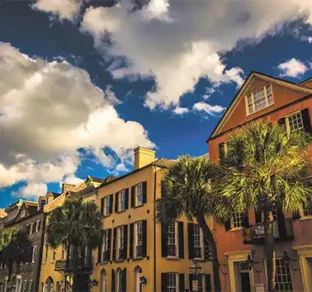 Charleston’s Broad Street, once known as its Wall Street, is among the city's oldest thoroughfares. Today the historic area is home to shops and restaurants.
© Jon Bilous | Dreamstime.com

On foot and by car, carriage and even an electric bike, I set out to find the soul of Charleston, South Carolina. In five days I discovered traces of the city’s nuanced history of war, plantations, civil rights and low-country traditions, thanks to its efforts to preserve and reckon with its past.
Charleston’s longstanding preservation ethic, which dedicated locals started in the 1920s, defines the city visually. There are no skyscrapers because local laws bar buildings higher than the 270-foot-tall steeple of the 1872 St. Matthew’s Lutheran Church. Hundreds of Federal, Greek Revival and Georgian-style houses still stand, emblems of the city’s past as a center of affluence.
Tucked-away gardens of camellias, live oaks, palmetto trees and dwarf palmettos soften the cityscape. Wrought-ironwork balconies and gates visually unify its streets. And ubiquitous pineapples symbolize hospitality.
Water, too, is a defining feature. Located between the Ashley and Cooper Rivers seven miles from the Atlantic Ocean, the city has cobblestone streets made from ships’ discarded ballast. Salt marshes, thick with swaying grasses, press against city limits. Five white-sand beaches lie just a short drive away.
Local crafts
In the old city market built in 1841, I scoured tables laden with locally made shell art, paintings, ironwork and unique sweetgrass baskets. Gullah-Geechee women, descended from enslaved people from West Africa, still weave them here with sweetgrass, bulrush and palmetto.
As one weaver, Vickie Gentile, told me, “I learned from my grandma.”
Distinctive deep-blue textiles and art made with dye from local indigo plants dotted every table. Indigo, cherished by Europeans, flourished here in the 1800s.
War stories
A port city, Charleston was a frequent target of pirates. In 1718 the city convicted two pirate captains and their crews, hanging as many as 49 sailors on the live oaks of White Point Park.
Charlestonians like to recount famous battles, starting with the Revolutionary War. In 1776 colonists defeated the British Royal Navy at today’s seacoast defense installation, Fort Moultrie. Island-based Fort Sumter, visible from downtown, is the famous Civil War site where the Confederates fired the first shot of that war in 1861. The Georgian-Palladian-style Old Exchange and Provost Dungeon, completed in 1771, survived two cannonball attacks. In the dank basement dungeon, the British in 1780 held 50 to 60 colonials, who coped with fleas, ticks, dysentery, cholera, bucket toilets and one meal a day.
This city is home to the H.L. Hunley, the first successful combat submarine in world history, which sank the Union Navy’s USS Housatonic in 1864. Divers discovered the Hunley, a three-foot by four-foot sub, in 1995. Visitors can admire her from a mezzanine above a 75,000-gallon tank. Artifacts from the submarine, including the captain’s gold pocket watch, a diamond broach and diamond ring, are on display nearby.
For more modern warfare, visitors can spend a day at the one-million-square-foot Patriots Point Naval and Maritime Museum featuring the World War II aircraft carrier USS Yorktown, the destroyer USS Laffey, the Cold War Memorial, a Vietnam War exhibit and myriad honors for American servicemen and women.
The Citadel, the Military College of South Carolina, has produced cadets and future military officers in its fortress-like Romanesque buildings and on its parade grounds since 1842. For a glimpse of Citadel life, observe the Friday dress parades or take a student-led tour. Straight-backed students whisk around carrying their bookbags in their left hands, right hands ever ready to salute.
Scars of the past
I explored 19th-century rice-plantation life, starting in several city mansions built with wealth generated from the work of enslaved people. In the Federal-style antebellum Manigault House, built in 1803, mahogany bed posts are carved as rice plants. The Nathaniel Russell House, built in 1808, home of a slave trader, features elaborate plaster gesso made of horsehair and glue, gilded capitals and a free-flying staircase.
“Charleston was built on slavery,” one guide told me, and I quickly learned that Charleston does not hide its scars.
At Magnolia Plantation, once a 2,000-acre expanse where enslaved people grew gold rice, my guide explained that the mansion, surrounded by towering live oaks with dangling Spanish moss, was built “after the war” because Union troops burned down the original home.
Another guide led a “Slavery to Freedom” tour of Magnolia’s four slave cabins built in the 1850s and used through the Reconstruction era. When the U.S. in 1807 imposed a ban on importing people for enslavement, the “controlling class” encouraged reproduction. By the time the Civil War started, the United States had nearly four million people in bondage.
Back in town, at the Old Slave Mart Museum I learned about the city’s history of selling people. Traders gussied up their “subjects” for auctions by bathing and shaving them so they would look “spry and smart” and divided them up by gender, skill and skin color.
The International African American Museum traces centuries of struggle, perseverance, anguish and achievement by the 12.5 million people forced into servitude worldwide. Its exhibits address the African diaspora, the 2015 murders at Charleston’s Mother Emanuel Church and the Minneapolis George Floyd murder in 2020.
My unease in absorbing the painful chapters of our history was leavened by appreciating the talents and accomplishments of many African Americans, including Frederick Douglass and Harriet Tubman.
Cuisine and carriages
I exercised little restraint in my gustatory adventures, sampling Charleston’s many variations of fried green tomatoes, BLTs with pimento cheese, she-crab soup with sherry and roe of crab, shrimp and grits, red-pea succotash and local favorite, Frogmore stew. This soupy amalgam of shrimp, corn pieces and sausage is also called a “low-country boil.”
Dishes with African roots pop up on many menus, enhanced with peanuts, sweet potatoes, okra, black-eyed peas and collard greens. I rarely had room for a benne wafer, a sweet and savory cookie with benne seeds introduced by Africans.
“There are no bad restaurants in Charleston,” local carriage driver Richard Knoth told me, after showing me his horse’s “Air Jordans,” rubber horseshoes nailed onto iron shoes to absorb the impact.
Rumbling around in a horse-drawn carriage offered a relaxed overview of the city. Charlestonians cherish their carriage horses — Belgians, French Percherons and American draft horses, all of the Clydesdale family — and locals brag that these steeds get three veterinary exams a year.
If horse-drawn tours aren’t your thing, other tours focus on the harbor, African American culture, history, food, plantations and nature, including the barrier islands nearby.
If you go
United Airlines has direct round-trip flights from Reagan-Washington National Airport for as low as $200 this fall.
A 45-room inn, The Ansonborough, in a former warehouse and paint factory, is quiet and convenient. It has a rooftop lounge and a grocery across the street, plus a speakeasy poker room hidden behind a bookcase.
Charleston has events year-round, like February’s Low Country Oyster Festival and the Southeastern Wildlife Exposition, which celebrates nature.
For more ideas, see charlestoncvb.com.
Travel 2026