


Baltimore houses get free solar power
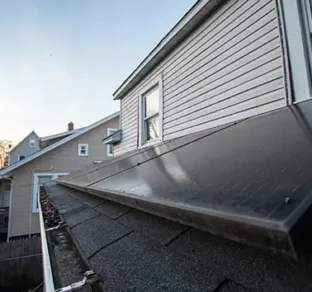 Solar panels provided under the Baltimore Shines program on a home in the city.
Photo by Sam Gauntt | Capital News Service

When Janete Gonzalez went to the Druid Hill Park farmers market in the fall of 2022, she was a new Baltimore City resident, having just moved after a house fire destroyed everything she owned. That day, she expected to leave the northern Baltimore market with food and maybe some health care products.
Instead, she left with solar panels.
“I originally assumed that solar panels were for people who had bigger land or lived in a better neighborhood,” Gonzalez said. “I just didn’t think it was for us.”
But Civic Works, a nonprofit working to improve energy accessibility in Maryland, is changing that.
After visiting the organization’s booth at the farmers market, Gonzalez joined its solar accessibility program. Now, she is one of more than four dozen Baltimore City residents who have received free solar panel installations as part of the Baltimore Shines program.
The program emerged as a partnership between the Baltimore City Department of Housing and Community Development and Civic Works as an affordable solution for low-income residents to lower their electricity bills and make a positive impact on the environment.
Baltimore Shines started this round of solar installs in 2024 and as of December had completed 50 solar installations for income-qualifying homeowners. By the end of 2026, the program hopes to bring that number to 170 installations.
“Our goal is to really make it as easy and worry-free a process as possible for the resident,” said Eli Allen, the senior program director at Civic Works.
Cost savings
After Gonzalez’s first introduction to Baltimore Shines, she went through an almost yearlong process of information sessions, online applications, a roof assessment and several house visits. Her solar panels were installed in June 2023, and by December, they were generating power.
Now Gonzalez saves about 50% on her Baltimore Gas and Electric Company bill. Bills that came in around $400 now average $176-$230 a month, she said.
“It gives that safeguard to really embrace the house that you have and lets you focus on family life,” Gonzalez said.
Those savings are nothing unusual. According to 2024 fiscal year data from the Maryland Energy Administration, Baltimore Shines has cut residents’ electricity bills by an average of $1,500 annually.
“That’s quite a significant amount,” said Angel Saules, Maryland Energy Administration program manager. “That’s over $100 a month that people are able to save by having these systems installed.”
On average, however, these savings are not consistent throughout the year due to seasonal changes in solar production.
Solar panels convert sunlight into electrical energy through photovoltaic panels. During the winter months, with fewer hours of sunlight, solar systems produce less energy. Coupled with an increase in heating needs, hot water usage and electricity for lighting, that means residents typically don’t save as much in their energy bills during the colder months.
“It’s great for the summer, not too much for the winter,” said Baltimore Shines participant Tyresa German.
In the winter, German said she saves about $50 per month; BGE bills that used to come in around $250 now average $200 per month. But once summer rolls around, German’s bills drop to $10-$30 a month.
“My friends hate me,” German joked. “Prior to getting the solar panels, I was doing a lot of overtime just so I could not feel drowned in the BGE bill.”
How it works
Baltimore Shines also ensures city residents aren’t drowned by the cost of solar panels.
In Baltimore City, the average row home can safely handle an 11-kilowatt solar system, which costs residents between $15,000 and $18,000, said Victor Walters, associate director of outreach and intake at Civic Works.
That price tag makes solar energy a luxury that is out of reach for some.
With Baltimore Shines, residents pay zero out-of-pocket costs — but only low-income homeowners qualify for the program. Income limits range from $26,338 for a single-person household to $54,600 for a family of four to $92,260 for a family of eight.
Under the program, Civic Works owns and operates the solar panels it installs on homes for a 20-year lease term, covering any maintenance issues or replacements residents may need.
To finance the program, Civic Works receives grants from a variety of sources, which previously included funding from a program called Solar for All.
However, after the U.S. Environmental Protection Agency terminated $7 billion in grants for Solar for All programs in August 2025, Baltimore Shines was forced to restructure to adjust for the lack of funding.
“We have had to cap the size of the solar system we are installing to be able to offer solar to more community residents,” Walters said.
Now residents’ solar systems are limited to 5.7 kilowatts — roughly half the size of previous systems installed under the program. If residents want to expand their system size, those costs come out of pocket, Walters said.
The Maryland Energy Administration Residential Energy Equity Program now serves as one of the program’s main funding sources — and it expects demand for the program to grow.
“The way we expect to see that unfold is that we’ll have more applicants for solar than we have in the past because there isn’t going to be access in other ways,” Saules said.
Why it matters
The chance to switch to solar matters for Baltimore City residents as BGE utility rates continue to climb. Since January 2025, BGE customers have seen multiple increases in their energy bills, with residents expecting to pay an average of $26.06 more per month for combined gas and electric bills, according to 2025 energy bill information for BGE customers.
Low-income residents bear the brunt of the energy burden. In Baltimore, the median energy burden of low-income households was four times higher than non-low-income households, according to a 2020 report by the American Council for an Energy-Efficient Economy.
The median household in Baltimore spent 3% of its income on its energy bill, yet median low-income Baltimore households spent 10.5%, according to the report.
Addressing the energy bills of low-income households simultaneously addresses climate change, Saules said.
“Our goals as a state are to reduce greenhouse gas emissions by a certain amount by a certain time,” Saules said. “A good way to achieve that goal is to address the highest energy burden, which is typically in lower-income households.”
Energy efficiency education is a crucial part of this conversation, she added. Being energy efficient can be as simple as knowing how your everyday behaviors affect your energy usage, like turning off the water while brushing your teeth and not constantly adjusting your thermostat.
At Baltimore Shines, solar panels are the first step in making a home more energy efficient. Then comes homeowner support and education to help residents understand how usage affects their electricity bills each month.
“When we install a new efficiency model in someone’s home, people sometimes think they can overuse any system,” Walters said. “People start to use more energy because they are assuming that this newer product is going to save them so much.”
Walters said staffers help residents feel confident in their decision to go solar. However, given the program’s limited staffing size, this support is not always as timely as residents want it to be, he said.
“The biggest feedback that we have gotten from program participants is not knowing step by step what’s going on,” he said.
In some cases, after residents have gotten their solar panels installed, they think their system will be turned on immediately. However, solar panels can sit on the roof of someone’s home for two to three months, awaiting city inspection and for BGE to connect the system.
To get ahead of such issues, Civic Works is working on new ways to improve communication with residents, Walters said.
But Gonzalez said the support she’s gotten from Civic Works has been a key part of her Baltimore Shines experience. The program goes beyond just covering finances; it’s about having access to resources to better understand the energy options available and how different systems will affect your finances and carbon footprint.
“I had access to learn about these things as a new homeowner — understanding the importance of energy savings and going green and all of these things we can do differently to contribute to the environment,” Gonzalez said.
For more information about the solar program, visit civicworks.com/solar, email info@civicworks.com or call (410) 366-8533.
—Capital News Service
Health 2026
#Recipes #Savvy Senior #Alzheimer’s Disease #Dear Pharmacist #health #vaccine #Nutrition #Health Study #Mayo Clinic