


Arena Stage’s play spotlights McCarthy era
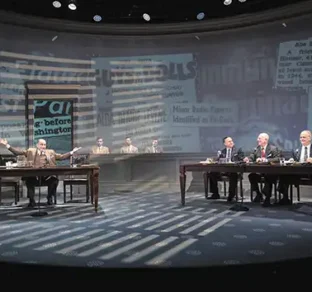 Based on actual transcripts, 'Are You Now or Have You Ever Been?' features Greg Stuhr, Peter Jacobson, Stephen Cefalu Jr., Aaron Bliden, Edward L. Simon, Jason Babinsky, John Leslie Wolfe and Philip Earl Johnson. The play runs through Dec. 6.
Photo by Teresa Castracane Photography

During volatile times, going to the theater can feel like attending a pep rally for democracy. Theaters seem to choose every production to reflect on current events. This is certainly true of Are You Now or Have You Ever Been? at Arena Stage through December 6.
The docudrama by immigrant playwright Eric Bentley directly quotes the heroism, struggle and treachery from the transcripts of subpoenaed Hollywood witnesses as they tangled with Congressmen at hearings of the House Un-American Activities Committee during the late 1940s and early 1950s.
Tony Award-winning director Anna D. Shapiro, fresh from her off-Broadway revival of the play, brings this thought-provoking production to Washington, D.C., where the hearings took place.
Moving performances
One of the most poignant witnesses in the play is Larry Parks (Aaron Bliden), who joined the Communist Party as a young idealist yet left it long before being called before the Committee. Thinking of his children and lost career, Parks delivers testimony that’s too nuanced for the Committee’s bluntly leading questions. Bilden’s facial expressions are equally nuanced and clearly reflect his turmoil as he repeatedly begs the Committee not to press him to name names.
After squashing Parks, the Committee Chairman (John Leslie Wolfe) is magnanimous in victory, blustering that, “If it’s any comfort,” the names given were already on the Committee’s list. Parks responds that it is no comfort.
The set is spare and nearly claustrophobic as one witness after another takes a seat at a table in the gray, wainscoted Congressional hearing room (Set Designer Andrew Boyce). The witnesses are pummeled by the flash and pop of lightbulbs of the media or ominously shadowed by lights filtered through blinds (Lighting Designer Donald Holder and Sound Designers Rob Milburn and Michael Bodeen).
At times, additional information about a witness appears as it is “typed” loudly on the backdrop, and shifting newspaper headlines are projected behind the actors (Projection Designer Brittany Bland). The effect can be a little busy.
The lights dim for young choreographer and dancer Jerome Robbins (played by Stephen Cefalu Jr.). His lean calm might be belied by his impatient smoking, but Robbins claims he believes it is right to name names. When the admiring and paternal Committee Chair urges Robbins to use his “God-given” talent to showcase American values through his ballets, however, the cold, disparaging look that Cefalu shoots him is unforgettable.
Robbins declares that his ballets are already always acclaimed for their American values. The Committee Chair urges, “Do it more.” He doesn’t seem to notice the tension in the room.
A few famous characters — Lillian Hellman (Rivka Borek), Lionel Stander (Jeff Still), Abe Burrows and Paul Robeson are played by strong actors, and many of their excellent performances drew audience applause.
Several lesser-known witnesses are portrayed by Man 1 (Edward L. Simon), Man 2 (Greg Stuhr) and Man 3 (Cefalu). The actors differentiated characters with mannerisms, accents and a hat. But their impeccable suits, many in shades of brown (Costume Designer Johanna Pan), may underscore an interchangeability that the Committee imposed — or tried to impose — as it broke the witnesses down without caring about personal consequences.
Committee members are also anonymous. Committeeman 1 (Philip Earl Johnson) and Committeeman 2 (Jason Babinsky) are, in turns, impatient, perplexed and threatening, as they self-righteously violate the rights of the American people in the name of the American people.
Yet they are no match for director and composer Abe Burrows (Peter Jacobson), who was best known for co-writing Guys and Dolls. He unleashes a sly vaudevillian humor as his superpower and, as he mugs for the cameras and us, the audience appreciates the lightened mood. Burrows offers droll observations and vague, twisted answers to tiptoe along the line between truth and lie, which confounds the Committee.
Paul Robeson’s testimony
As steadfast and upright as Hellman and Stander are as part of the Hollywood Ten, the final witness is the production’s moral and dramatic highpoint.
With a regal voice matched by keen observations and informed fury, Paul Robeson (played by a mesmerizing Kevin Mambo) turns the tables on the Committee. He sees through their self-righteousness, noting at least one member’s dubious background as a white supremacist. They still wield power. The Committee did withhold Robeson’s passport and stymie his career, but they must have felt his moral and intellectual superiority. We certainly do.
This strongly acted play resonates for many reasons. The witnesses who are broken by the Committee’s threats to reveal their secrets or ruin their careers are moving, while those who put their consciences first are inspiring.
Arena Stage at the Mead Center for American Theater, located at 1101 6th St. SW, Washington, DC, is a few blocks from the Waterfront Metro Station. The concierge desk can connect attendees to Lyft or taxicabs, and the center has its own onsite parking garage.
The show, at 1 hour and 45 minutes without an intermission, moves quickly. Although no senior discounts exist, discounted tickets are available in person two hours before curtain for most performances. In addition, veterans, educators and first responders get 20% off. For tickets, see tickets.arenastage.org/events.
Arts 2026
#Bibliophile #Bob Levey #Theatre #Books #Baltimore #New Love After 50 #Artist #Love After 50 #Art






