

Books take on aliens and biological warfare

In our era of scientific discoveries and breakthroughs, science fiction has become more credible. Two nonfiction authors use documented astrophysics and proven microbiology to debunk and project some common scenarios in science fiction.
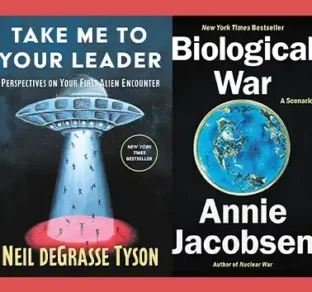
Take Me to Your Leader: Perspectives on Your First Alien Encounter, by Neil deGrasse Tyson, Simon Six 2026, 240 pages
In one of the funniest and best-written books you will read, astrophysicist Neil deGrasse Tyson, 67, director of New York’s Hayden Planetarium, concludes that intelligent life exists beyond Earth. However, forget everything you may have learned about it. Tyson approaches his task with scientific rigor that will make you simultaneously think and laugh.
The magnitude of the universe, with its myriad inhabitable planets, proves his first point. So do the age of the galaxies and the time it takes for intelligent life to develop.
Yet so far we have neither observed nor encountered extraterrestrials. Indeed, they have never made their way here, and current science considers it impossible. We have no idea of the behavior or appearance of an extraterrestrial being.
Tyson disproves cable TV claims that aliens carved markings on Stonehenge or constructed the Pyramids; he personally duplicated the carvings and attributes the myth about Egypt to racism.
Modern telescopes have not detected Martian “canals” harboring life. A field of “extraterrestrial fossils” actually contains earthly remains. A model that one “scientist” offered Tyson was actually a poorly glued pastiche of human and animal bones. NASA’s diagrams to attract aliens defy science.
Creatures with large eyes (and small brains) lack the intelligence, and giants the mobility, to travel to Earth. “Spaceships” lack the deceleration to land safely. In any case, extraterrestrials would dismiss us. Aliens may not recognize us, mistaking cars for humanity.
Tyson suggests proper etiquette if we ever meet intelligent life: Do not shake hands or wave. Instead, carry a Pythagorean triangle or similar tokens.
Biological War: A Scenario, by Annie Jacobsen, Penguin Random House 2026, 406 pages
The Biological Weapons Convention banned them 51 years ago. Yet nations (Russia) cheat. Others (the West) develop pathogens, ostensibly for defense. Some genetic engineering leads to cures for diseases. What happens if deadly viruses escape? Biological Warfare, based on investigative journalist Annie Jacobsen’s interviews with 52 experts, depicts a slow-motion global collapse.
Jacobsen, 59, a Pulitzer Prize finalist, teases with a story. A reveler unwittingly inhales a pathogen laced with a euphoriainducing chemical. He coughs and comes into contact with people as he parties and travels through busy airports to a heavily populated metropolitan area. Of course, his body breaks down, but the euphoria prevents him from taking measures. When it wears off, the person dies a horrible death. (Life parallels fiction: Last month, a Russian researcher inhaled deadly plague and exposed hundreds of others to the pathogen.)
Next comes the history of contemporary research. Leonid Brezhnev personally authorized a clandestine program to wipe out the entire population of the West, while leaving everything else intact. Shockingly, he succeeded. A U.S. scientist discovered genetic engineering, which, when made public, allowed Soviet scientists to design a weapon that unleashes multiple diseases in one pathogen, especially those without developed countermeasures.
Finally, back to the doomsday scenario: An explosion at a Russian lab thrusts biological agents into the air, and, in a page-turner, we see the world end slowly.
Arts 2026
#Bibliophile #Bob Levey #Theatre #Books #Baltimore #New Love After 50 #Artist #Love After 50 #Art