

Frankenstein brings fact and fiction to life
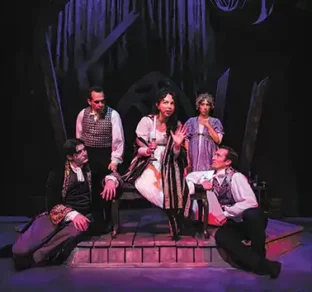 Fabiolla Da Silva plays Mary Shelley, who spins a ghost tale for her friends in 'Mary Shelley’s Frankenstein,' through Nov. 8 at the Chesapeake Shakespeare Company.
Photo by Kiirstn Pagan Photography

In May of 1816, from a cauldron of circumstance and imagination, came forth a work some say represents the birth of science fiction as a literary form.
The circumstance? A tremendous volcanic eruption that forced five friends to stay shuttered indoors in a gloomy, sunless summer, cold, idle and bored.
The five friends happened to include the future Mary Shelley, whose imagination would craft that most famous novel of life from death reanimated, Frankenstein.
The story, adapted for the stage by David Catlin, is now playing at the Chesapeake Shakespeare Company’s theater in downtown Baltimore.
Directed by Ian Gallanar, the play offers audiences a delightful mix of the real and fantastic — as one character notes, between “waking and dreaming” — as we move between the true tale of how friends competed to pen the most frightening “ghost story,” and the tale of Dr. Victor Frankenstein and his unholy creation.
Strong acting
Mary Shelley’s Frankenstein provides moments both mirthful and macabre. These often spark the scenes as this fine ensemble cast toggles between dual roles — the historical figures and the characters in Shelley’s fantasy.
Romantic poet Lord Byron (Joshua Williams), Dr. John Polidori (Jose O. Guzman), Claire Clairmont (Dawn Thomas Reidy), poet Percy Bysshe Shelley (Vince Eisenson) and Mary Wollstonecraft Godwin (Fabiolla Da Silva) gather in Villa Diodati, a Swiss mansion Byron rented on Lake Geneva.
Williams’ performance is particularly impressive as he moves from the “monstrous” Byron — noted in history for being volatile, defying moral boundaries, even dubbed “a second Caligula” — and the Creature, whose anger and sadness at being rejected by his creator and humanity itself hang heavily upon him like the soiled, stained cloak he wears.
Reidy shows great range, from playing the pregnant Claire Clairmont, in an intense affair with Byron, to a 7-year-old boy and an Orkney Island fisherman comically convinced Victor is a murderer.
Da Silva plays two sides of the same coin, as both real-life lover of Percy Bysshe Shelley and “more-than-sister” to Dr. Frankenstein. Both characters are a tempest of uncertainty when it comes to their roles in their respective men’s lives, and Da Silva merges the two flawlessly.
Guzman similarly handles multiple roles, from Dr. Polidori to sea captain Walton to Victor’s closest friend, Henry.
Much applause should be saved for the production’s creative team, who conjure the stormy night at Villa Diodati, where the five friends gather with peals of thunder and even bolts of red lightning that must be experienced to be truly appreciated.
A favorite scene is conceived as Victor assembles, and then destroys, the Creature’s companion. Cloaked puppet artists masterfully manipulate life-size puppetry (designed by Chris Reuther), whose movements bring what is literally inanimate convincingly to life.
Like a Shakespearean tragedy, by play’s end, nearly all, both the real and imagined, have found their “way to dusty death,” to quote Macbeth.
Though now more than 200 years old, Shelley’s work continues to find ways to resonate with modern audiences. After all, Dr. Frankenstein is not unlike the 21st-century Prometheuses who would reject their responsibility for the “new life” they create: the creature we now know as AI.
Mary Shelley’s Frankenstein continues its run at the Chesapeake Shakespeare Company, 7 South Calvert St., Baltimore, through Sunday, Nov. 8. For tickets, contact the box office at (410) 244-8570 or visit chesapeakeshakespeare.com.