


Memoir describes life on the reservation

Life doesn’t always go in the direction you think it will. Sometimes the journey is longer; other times it is accelerated. Even when life doesn’t take you where you want, it can sometimes place you exactly where you need to be.
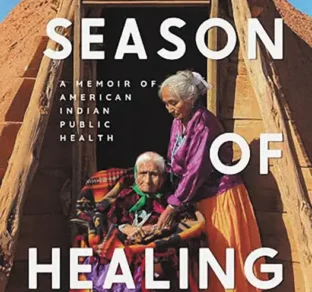
That is how it felt for Gene Gerber, DDS, MPH, a retired public health professional who this year published his memoir, Season of Healing: A Memoir of American Indian Public Health.
Now in his early 80s, Gerber divides his time between Lutherville, Maryland, and Fernandina Beach, Florida. In his book, he reflects on the journey that led him to a career in the Indian Health Service.
Gerber grew up in Mount Washington and Towson, Maryland. After college, he worked as a stockbroker, then started law school. Neither seemed like a good fit.
“I just didn’t feel satisfied,” Gerber said.
His father-in-law, a plastic surgeon in Baltimore, suggested medical school instead. After meeting the requirements for both medical and dental school at the same time, Gerber decided to pursue dentistry.
Because the Vietnam War was underway, Gerber wanted to study for another reason: the student deferment. “I had a motivation of staying in school, since I didn’t want to go to Vietnam,” he said.
Four years later, Gerber earned his dental degree at a time when physicians and dentists had a two-year military obligation under the Berry Plan.
While weighing his options, Gerber decided to look into serving in the Indian Health Service.
“I ended up starting in the Indian Health Service as the only dentist for 6,000 Apache Indians on the San Carlos Indian Reservation in Arizona,” he said.
From 1970 to 1972, Gerber saw firsthand “how great the need for medical and dental care was, how underserved [Native Americans] were,” he said.
After fulfilling his obligation, Gerber moved back to Annapolis, Maryland, with his wife and daughter and practiced privately for the next seven years.
Despite the success of his practice, something in him was still drawn to the San Carlos Apache Reservation. Gerber describes this feeling of needing to return — a calling, even — in his memoir.
“I missed the community on the reservation. I missed the patients. I missed the ability to do interesting things. It was kind of a longing for more of that experience that I’d had serving,” he said.
So, in 1978, Gerber returned to Arizona, this time to serve and practice on the Navajo Reservation. He found that the day-to-day rewards of making a difference and contributing to a community meant a lot to him.
“It was a sense of accomplishment, a sense of community, a sense of the amazing spirit and culture of American Indians that kept me going,” he said.
Observing history
Gerber felt gratified to watch what Native American communities achieved throughout his decades out West.
When he first started practicing, the U.S. government had a controlling, paternalistic approach to Native American health care.
Over the years, the tribes have been able to reclaim their agency, allowing them to make decisions about their healthcare and what is best for them.
Through several acts passed in the mid- 1970s, tribes were allowed to “take direct administrative control of health programs through contracts and compacts,” according to the Indian Health Service’s website.
For Gerber, that shift became one of the most impactful parts of his work. His role was not to direct that change, but rather to support the tribes during the process.
“The journey isn’t finished,” Gerber said. “The disparities haven’t disappeared, but the responsibility and the hope now rest almost completely in Indian hands, and that, to me, is the most meaningful progress of all.”
Advice to older adults
Gerber, who retired from the Indian Health Service in 1996, found fulfillment not from status or recognition, but by helping others and seeing them thrive.
“Everybody has something to offer, and everybody has something to teach us,” he said.
That idea applies to writing a memoir, too. No matter what kind of life you’ve had, your story may help others — strangers, your family, or even yourself.
The process of writing his memoir, published in May by Bonito Press, has given him a sense of peace.
To those who are still searching for a sense of meaning or fulfillment later in life, Gerber’s advice is simple:
“Write a memoir. It gives you a chance to have a perspective on your own life, your role in our society, whatever contribution you were able to make, and also to codify these memories for your children and grandchildren.”
Season of Healing is available on Amazon in paperback and Kindle format.
Arts 2026
#Bibliophile #Bob Levey #Theatre #Books #Baltimore #New Love After 50 #Artist #Love After 50 #Art






