


New nonfiction books to read this fall
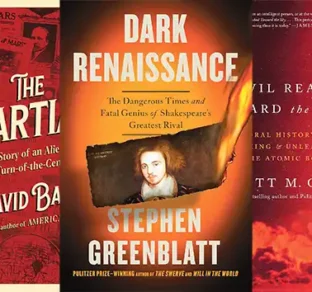

The Martians: The True Story of an Alien Craze That Captured Turn-of-the Century America, by David Baron, Liveright, 2025, 336 pages
Talk about fake news: In 1907 a New York Times banner headline declared, “There Is Life On the Planet Mars.” Upping the ante the next year, the stodgy Wall Street Journal claimed “proof” of “conscious, intelligent human life” on our red neighbor.
Science writer David Baron revisits a decades-long cultural phenomenon in The Martians: The True Story of an Alien Craze That Captured Turn-of-the Century America. He explores how a society on the cusp of reality-piercing scientific advances — global radio communications, X-rays, Einstein’s Theory of Special Relativity among them — bought into what in hindsight seems downright silly.
The idea of life on other planets had been orbiting the public imagination ever since the realization that the Earth wasn’t alone in the solar system. As Baron explains, advances in telescopes provided breakthrough views of an alien landscape that led to unbridled theorizing in extraterrestrial life, even civilization, all sparked by an innocent mistranslation.
While several astronomers in the late 19th century had observed the large patches of different colors and shades on our closest heavenly neighbor, Italian Giovanni Schiaparelli published them on a map.
Projecting Earth-like characteristics, he connected Mars’ larger, darker areas thought to be oceans, with thin, linear features he labeled “canali,” Italian for “channels.” Misreported in English as artificial waterways, “CANALS ON THE PLANET MARS” headlined The Times of London in 1882.
From there, Baron tells a compelling story in which mankind’s greatest power, compelling storytelling, unleashes a tenuous scientific observation that drives premature speculation, and a thin veneer of logic spawns runaway flights of fancy.
No one was more spellbound than a Boston Brahmin armed with a Gilded Age fortune, Percival Lowell. Following a distinguished stint as a diplomat in the Far East, Lowell devoured the emerging Mars debate in print in the early 1890s.
Dedicating his life and resources to further study of the nearby planet, the 39-year-old traveled to the Arizona territory to spend countless nights peering at the cosmos.
Over the following years, Lowell did more than anyone to gather what he claimed was visible evidence of engineering on Mars. Though an amateur scientist, he deployed his Harvard erudition to write well-received books and deliver sold-out lectures, all to broaden the acceptance of the canal theory and the possibilities it opened.
When in 1971 the American spacecraft Mariner 9 photographed Mars’ first closeups proving the absence of canals, sci-fi writer Arthur C. Clarke responded, “Whatever we can say about Lowell’s observational abilities, we cannot deny his propagandistic power.”
In The Martians, Baron captures the milieu spanning the ends of the Victorian and Edwardian eras without jeering at their lack of modern sensibilities. He leaves most opportunities for media criticism or parallels to today’s conspiracy theories to the reader, and judges Lowell gently by focusing on the many researchers and writers his works inspired.
As Percival Lowell himself observed, “Ideas are as catching as scarlet fever.”
—Douglass K. Daniel
Dark Renaissance: The Dangerous Times and Fatal Genius of Shakespeare’s Greatest Rival, by Stephen Greenblatt, W. W. Norton & Company, 2025, 352 pages
The English poet and playwright Christopher Marlowe was born in 1564, the same year as his frenemy William Shakespeare. Yet it is quite possible you never heard of him.
Except you have. Marlowe was the guy who wrote about Helen of Troy, “the face that launched a thousand ships” (Doctor Faustus). Who penned the much-imitated line “Come live with me and be my love” (“The Passionate Shepherd to His Love”).
In his riveting new biography, Dark Renaissance: The Dangerous Times and Fatal Genius of Shakespeare’s Greatest Rival, Harvard scholar Stephen Greenblatt explores Marlowe’s short, subversive life and argues that it was he, even more than Shakespeare, who “awakened the genius of the English Renaissance.”
Born to a poor cobbler in Canterbury, “Kit” Marlowe was a prodigy from the start. He won a scholarship to a private secondary school, where he was first exposed to Greek and Latin poetry and “a whole world opened up.” From there, it was on to Cambridge, again on a scholarship, where he earned his bachelor’s and master’s degrees.
Under ordinary circumstances, a boy from his humble background could have looked forward to a career in the church. But nothing about Marlowe was ordinary.
Indeed, Greenblatt argues that during the years he was pursuing his master’s degree, he was likely recruited as a spy for the royal court, tasked with hunting down Catholic subversives plotting to overthrow the Protestant monarch. Then, at age 29, he was killed in a bar fight for reasons that are not entirely clear, though Greenblatt suggests he had run afoul of authorities because of his “transgressive” personality, including being an atheist and queer.
In Greenblatt’s previous books, including Will in the World, his best-selling biography of Shakespeare, and the Pulitzer Prize-winning The Swerve, he emphasized the importance of cultural context in understanding literature, the so-called “new historicism.” In Dark Renaissance, he does so with dazzling effects, evoking England circa 1580 as an almost dystopian backwater:
“Narrow lanes were filled with excrement and offal. On London Bridge…severed heads of convicted traitors were stuck up on spikes.” Then, Greenblatt writes, “not instantly but with startling rapidity,” everything changed, with one “remarkable figure” embodying the “ferocious energy and daring” of the era.
That figure wasn’t Shakespeare; it was Marlowe.
—Ann Levin
The Devil Reached Toward the Sky: An Oral History of the Making and Unleashing of the Atomic Bomb, by Garrett M. Graff, Avid Reader Press / Simon & Schuster, 2025, 608 pages
The story of the Atomic Age’s start is a fascinating one about the power of invention and a chilling one about its consequences. In The Devil Reached Toward the Sky: An Oral History of the Making and Unleashing of the Atomic Bomb, Garrett M. Graff creates a comprehensive account of what seems like a well-told piece of history by including voices that have been either little-heard or missed altogether in the eight decades since the atomic bombs were dropped on Hiroshima and Nagasaki.
Graff at the outset acknowledges his book is adding to a history that feels well-worn, from historian Richard Rhodes to filmmaker Christopher Nolan.
But Graff manages to stand up to even those accounts with voices that help the reader see what it was like on the ground. It includes life at Los Alamos, New Mexico; Oak Ridge, Tennessee; and Hanford, Washington as scientists raced to develop the atomic bomb before Nazi Germany.
The most powerful portions of the book come in the final chapters, which focus on the bombing and the aftereffects of the bombing in Hiroshima and Nagasaki. No writer could describe the hellscape that the bombs unleashed better than those on the ground who survived it.
“My God, what have we done?,” Capt. Robert A. Lewis, co-pilot of the Enola Gay, is quoted in the book as saying.
The voices Graff mines help begin to answer at least part of that question.
—Andrew DeMillo
Arts 2026
#Bibliophile #Bob Levey #Theatre #Books #Baltimore #New Love After 50 #Artist #Love After 50 #Art






