


The Score scores big at Shakespeare Co.
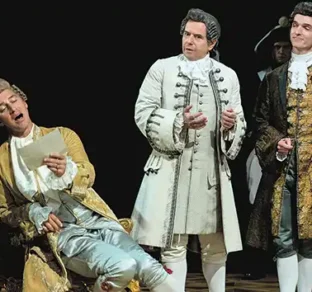 Stephen Hagan, playing King Frederick II, holds court with Christopher Staines, Toby Webster, Matthew Romain and Jordan Kilshaw in the U.S. premiere of 'The Score,' at the Shakespeare Theatre Company through Oct. 25.
Photo by Teresa Castracane Photography

Frederick II of Prussia was an Enlightenment king who composed music, invited the Age of Reason philosopher Voltaire to Potsdam, and guaranteed religious freedom for his subjects. Instead of Louis XIV’s declaration “I am the state,” Frederick the Great famously said, “I am the first servant of the state.”
A rather different depiction of Frederick (portrayed with roguish autocratic arrogance by Stephen Hagan) takes the stage in Oliver Cotton’s drama The Score. The play, at the Shakespeare Theatre Company until October 25, is directed by no less than the famed English director Trevor Nunn and stars the charismatic Scottish actor Brian Cox.
Johann Sebastian Bach arrives in Potsdam to visit the Prussian king and his son Carl Philipp Emanuel Bach (played sympathetically by Jamie Wilkes). The younger Bach works as a musician for the king, along with three sycophants: court composers Carl Graun (Matthew Romain), Johann Quantz (Christopher Staines), and Franz Benda (Tony Webster).
The Baroque style of J.S. Bach is sliding out of fashion in 1747, and historically C.P.E. Bach is bridging the Baroque and Classical eras in a way some have termed Mannerist (a historical achievement not brought out in the play).
Yet the elder Bach nonetheless shows his genius as he strives to invent an impromptu three-part fugue based on a melody composed by the king. The king and his three servile court composers bet against his doing so, with loyal Carl as the only one on his father’s side. Could, perhaps, a musical “score” emerge from this competition?
History lessons
In the playbill, theater critic Drew Lichtenberg suggests there is some historical evidence that the king challenged Bach to invent a fugue.
A focal point of the play — which is less historically based but which the audience may find even more riveting — is Bach’s daring rebuke of the king for war crimes his soldiers have committed, which have gone unpunished. The play presents the dilemma of how the humanistic ideals of the artist are juxtaposed against the harsh nature of war, which even a king may (or may not) be powerless to control.
Peter De Jersey gives a flamboyant portrayal of Voltaire, who seems at first to be a court flatterer but privately agrees with Bach and admires his courage to be so outspoken. Voltaire, endorsing Bach’s revulsion at the ruthlessness of war, quotes these insightful and relevant lines from Hamlet (this is, after all, the Shakespeare Theatre Company):
To my shame I see
The imminent death of 20,000 men
That for a fantasy and trick of fame
Go to their graves
A musical delight
The music of J.S. Bach is played throughout the production, rendering it a musical as well as theatrical experience. The set and costume designer are the same person, Robert Jones, whose costumes reflect in some cases the elegance of the 18th-century era and in some cases its practicality. Frederick the Great is seen much as he appears in portraits. Meanwhile, the sets are conversely deliberately restrained, even within the palace walls of Potsdam, thereby giving greater focus to the themes of the play.
The Score may remind some of the Mozart-based play and film Amadeus, which brings a composer and his political milieu from the distant past into modern focus, humanizing and reimagining historical figures. The play thus has great interest beyond fans of classical music, the Baroque era and turbulent 18th-century history.
The Score runs at the Shakespeare Theatre, 610 F St. NW, Washington, D.C., until October 25. Audience members 60 years and older are eligible for a 10% discount on tickets or a 35% discount for weekday matinees. Rush tickets start at $40 and are available one hour before showtime.
For tickets and discounts, call the box office at (202) 547-1122.
Arts 2026
#Bibliophile #Bob Levey #Theatre #Books #Baltimore #New Love After 50 #Artist #Love After 50 #Art






