


Two nonfiction books for winter evenings
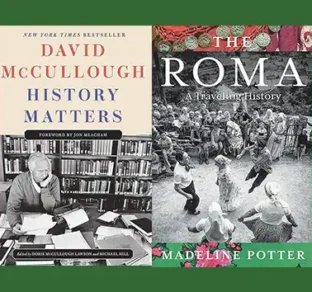

History Matters, by David McCullough, 192 pages, Simon & Schuster, 2025
The late Pulitzer Prize-winning historian David McCullough told an audience in 2012 that writing history was like working on a detective case.
“And once on the case, you want to know more and more and more,” he said in remarks at Dartmouth College. “Follow your curiosity.”
One thing that’s clear after reading History Matters, a posthumous collection of McCullough’s writings and speeches that include his Dartmouth remarks, is how much the revered historian practiced what he preached.
The book is an enjoyable complement to McCullough’s canon, which includes biographies of John Adams and Theodore Roosevelt, and a reminder of why he was one of the greatest historians of our time. It also offers a glance into his approaches to reading and writing.
In a tribute to the late novelist Herman Wouk that’s part of the collection, McCullough underscores the importance of feeling and narrative writing for historians. Another tribute to novelist, painter and historian Paul Horgan shows how McCullough approached his writing with a painter’s eye.
The writings also include a short history of his typewriter, a second-hand Royal Standard that he bought in 1965 and used to write every one of his 12 books. A recommended reading list from McCullough underscores how much he viewed literature as necessary for understanding history.
Throughout the book, McCullough’s remarks display concerns about the consequences of historical illiteracy. His pieces also illustrate the power of helping out younger writers and connecting with them. Overall, the collection offers a brief introduction to McCullough for readers not familiar with his works, but it pales in comparison to the value of reading his books. Hopefully, it will inspire readers to delve into McCullough’s writings.
—Andrew DeMillo
The Roma: A Traveling History, by Madeline Potter, 272 pages, Harper, 2025
The Roma: A Travelling History is a fascinating look at a marginalized and misunderstood group of people who have encountered hostility for centuries.
Written by Madeline Potter, a scholar of 19th-century Gothic literature, the new book recounts how members of the group long have been maligned, enslaved, deported and murdered.
Potter, who grew up Romani in post-communist Romania, weaves together memoir and archival research into what is described as the first contemporary history of the Romani people.
Instead of being raised in an intricately carved horse-drawn “vardo” that traveled from camp to camp, Potter passed her childhood in a towering Soviet-style hig-hrise, a more typical upbringing as the Romani people increasingly leave life on the road to become “settled.”
In her book, Potter carries us from England, where she currently lives, to Romania, Bulgaria, Hungary, Austria, Germany, France, Spain, the U.S. West Coast and finally to Sweden.
Potter tells of how King Henry VIII passed the “Egyptians Act” in 1530, calling for the Gypsy people to be expelled from England due to their alleged crimes, including “robberies,” “palmistry” and “deceit.”
Believed to have migrated from northern India to Europe some 1,500 years ago, and with a language rooted in Sanskrit, the Roma were once thought to have originated in Egypt.
In Spain, they have been known as Gitanos. During Spain’s 1749 “Gran Redada de Gitanos” (Great Gypsy Roundup), some 10,000 Roma were detained, and families were separated, with the men sent to work in shipyards and the women and children to factories.
In Nazi Germany, the Reich Office for Combating the Gypsy Menace set the scene for the Roma and related Sinti people to be rounded up and sent to concentration camps alongside Jews, members of the LGBTQ+ community and other minorities. As many as 500,000 Roma and Sinti are estimated to have been murdered by the Nazis and their collaborators during that period.
Despite the continued discrimination, the Roma have made important cultural contributions, Potter writes.
Potter mentions Carmen Amaya, a Spanish Romani who was known in the mid-20th century as the world’s best flamenco dancer. Composer Franz Liszt was so enamored of Hungarian Roma traditions that he absorbed them into his 19th-century work.
“There is much sadness in our history, and much pain,” Potter writes. “But importantly it’s not pain that beats at the heart of our story. On each step of my journey, I encountered the wondrous stories of those who have decisively resisted their marginalization, who have refused to be silent and whose stories continue to inspire the Roma today.”
—Anita Snow
© 2025 The Associated Press. All rights reserved.
Arts 2026
#Bibliophile #Bob Levey #Theatre #Books #Baltimore #New Love After 50 #Artist #Love After 50 #Art






